Coach PMs on Evals with Six 1:1 Questions
Six questions for your next 1:1 that show whether your PMs are calibrating their AI judges or just accepting what the agent produces.


Last week, the water stopped running in our building. The neighbor chat group in WhatsApp exploded.
I went to report the issue. My landlord forces us to talk to a chatbot in order to communicate with them. The chatbot tries to fill out their internal forms that I can't access. In doing so, it discards all of my words and rewrites everything I say. This meant that when I tried to report "no running water", it reformulated that to "broken pipe and active leak".
As I tried, repeatedly, to tell the chatbot our water was out, and watched it mis-formulate again and again, I felt deeply frustrated.
The good: I got an immediate callback from an alarmed person at the management company. The bad: It totally missed the point on what I was trying to say.
My guess is that the software vendor had integrated a small, cheap model for its chatbot, and hadn't really looked at evals or calibration. (I think many of us were guilty of this for our first LLM integration - get it working well enough, and see what the users think!) But these days, that's not enough. Users are getting mad.
I’m building an AI agent for hiring teams, on both US and EU models. I'm using Claude Code for the project, but I asked Claude to make sure I learn about evals along the way because I have a sense that, like behavior-driven development, this is an important area to understand for PMs who care about quality.
Context
Your org is building agent features for your product. The teams have got something in place that looks good at first, but the result feels a little generic and weird when you play with it. It's not clear how reliable the agents are. Maybe you've done a limited release and don't have much feedback yet, or you're trying to decide whether releasing will wreck your brand and customer relationships. You'd like to hire some experts in this, but you're not sure if you need PMs with agent experience, forward-deployed engineers, or agentic UX people - and in any case you're not sure how to interview for this new skillset.
Discussion
Evals are showing up in every job description, it seems. But what are they, really, and should PMs be writing them?
Evals are like automated tests, but for non-deterministic behaviors. An eval specifies the range of acceptable outputs: what needs to be present in a model output for it to be considered good?
If you're making evals for a chatbot, for example, you might write:
- some personas (in my recruiting case, a hands-off restaurant franchise owner and a fry cook who's tired of being yelled at)
- some scenarios to put those personas in (they need to hire a new manager because the last 3 quit without giving notice)
- the output expected (previous managers were really aggressive with the team, causing accidents and learned helplessness, but the owner has no idea)
Add more detail to these, and then you use a second model to simulate real people in these scenarios, and a third model to judge the output your app generates and score it on how well it satisfies the scenarios.
You also need to calibrate the judge.
All of these steps are important. And... your agents will happily do all this for you, but should you let them?
Writing the eval cases
I hand-wrote evals for a first hiring scenario. I wrote out a two-person hiring team, which took some effort. Then Claude wanted a second scenario, and offered to build it for me. It came back with some pretty compelling characters and disagreements for 4 people trying to hire a VP of sales at a growth startup. One character was trying to pitch himself for the role. The founder wasn't really sure he could let go of big deals. It was realistic enough. The disagreements were meaningful.
This made me think: Do I really have to hand-write this stuff? Given the quality, there's a good argument for generating personas and scenarios. But this generation needs to be seeded by the real context you're in. In my case, Claude had a product brief framed with my understanding of the user problem.
So of course what it came back with was compelling to me.
The problem is that we product people carry our own biases about user needs, and we're often wrong. So if we generate evals with just one prompt, we often just encode our own biases into them.
So avoid just starting with one prompt.
Bad:
Generate evals for hiring teams who disagree about what to hire. Do teams for 3 different senior roles at growth startups.
Better:
Interview me about the key things I've observed in talking to hiring teams about their struggles to agree on who to hire. Ask me up to 20 questions to help you generate meaningful personas and evals.
Best:
Here are the transcripts of 10 user interviews I've conducted. Analyze them: first list observations about what people said, then generate reflections on possible subtext, then generate interpretations about what's going on. Before sharing this with me, ask me questions about my own observations. Then update your interpretations about the biggest challenges and share the list with me. After discussion, use this to generate evals with representative personas and cases.
This can be done by the PM, or the UX person, or the QA person. (Or if you're a dev and all those people have been laid off, you can do it yourself).
Calibrating the judge
Claude is great at setting up the judge and devising a scoring system. But because I had asked Claude to teach me along the way, it annoyed me by demanding that I calibrate the judge.
I was doing this at the end of a long day, while slightly distracted, trying to make sense of these complex cases in the terminal window, with the fixed-width font that is so helpful when reading code and so unhelpful for everything else. I found it really tough to juggle windows to calibrate the judge. So I asked Claude to build me a UI for this.
It was still really tough. I answered inconsistently. Claude called me out on this. I just wanted to wrap this up and be done with my day.
Then, we realized the inconsistencies were showing us something meaningful. That in our scenario (an agent that surfaces disagreements about hiring) it was not important for the synthesizer to catch every issue. It's not reviewing legal documents or medical devices. It is, in fact, better if it doesn't catch every issue, because then you get a summary that's shorter, more readable and meaningful.
The point is: the nature of the judging really does matter, and it's domain-dependent.
There's a name for this weird chicken-and-egg problem. Shreya Shankar, then a researcher at Berkeley, called it criteria drift - criteria are needed to grade outputs, but you can only find the criteria by grading the outputs. You have to wade through a messy cycle of, "yes, I know that's what I said I wanted, but it's not quite right".
Calibrating the judge is a qualitative judgement. If you do not do this yourself, you're putting software slop into the world. Someone needs to sit down with a clear head and compare outputs.
In Thinking, Fast and Slow, Daniel Kahneman highlighted something that was observed with parole judges - they were more likely to issue favorable decisions after meal breaks, and less so later in the day, presumably when they're tired and hungry.
The size of this effect has since been questioned, but I have learned I cannot do this kind of work at the end of the day. After a string of back-to-back calls without a break, my brain starts looking for shortcuts, and that means a lot of telling Claude 'It's fine'. So for me, this work needs to be booked in the morning, at 9 or 10 am. You need to schedule this work. In your calendar. Decline some other meetings. It's that important.
Calibration is product design
Judge calibration is a key part of the design of the agents. It is product design in a very pure form. If you have a UX person, especially a researcher, PMs should sit with them to do this work together.
As you're doing it, you may discover that you now want Claude to change your scenarios and personas to highlight new things. That's good.
The first pass of judge calibration is about getting something you're not embarrassed to show to users. Then later passes are about changing the design of the outputs to solve the problems users told you about.
Evals and calibration are not a substitute for showing results to users and asking if they are useful. The reason my evals were off was that I had been accepting 'decent' briefs from my app without really noticing that they weren't solving the real problem for users. The faster we build with AI, the more tempting it is to skip talking to users. This is the build trap, and the way out is to get back to talking to real people. Claude Code won't do this for you.
The calibration work led me to redesign the output brief to make it shorter, and to instruct the synthesizer to include less detail. And the next step for me is to test the briefs with real recruiters.
Surprisingly, the judge itself doesn't always need to use an advanced model. I tested the app on several US and EU models (Opus, Sonnet, Haiku, and Mistral Medium 3.5 and Large 4). The calibration showed that the cheapest one, Haiku, also agreed with me, so we were able to use it to score the EU models and save some cost. (Yes, I use US models for building, but they only see synthetic data. All customer data can still go through an all-EU stack).
Play
Anyone on the team can do the initial eval generation. Calibrating the judge is product design in a very pure form - ideally PM and UX, sitting together, informed with real user data.
PMs are strapped for time. Given this, I'd prefer most PMs calibrate the judges rather than hand-write every eval themselves**.
What to say to your PMs
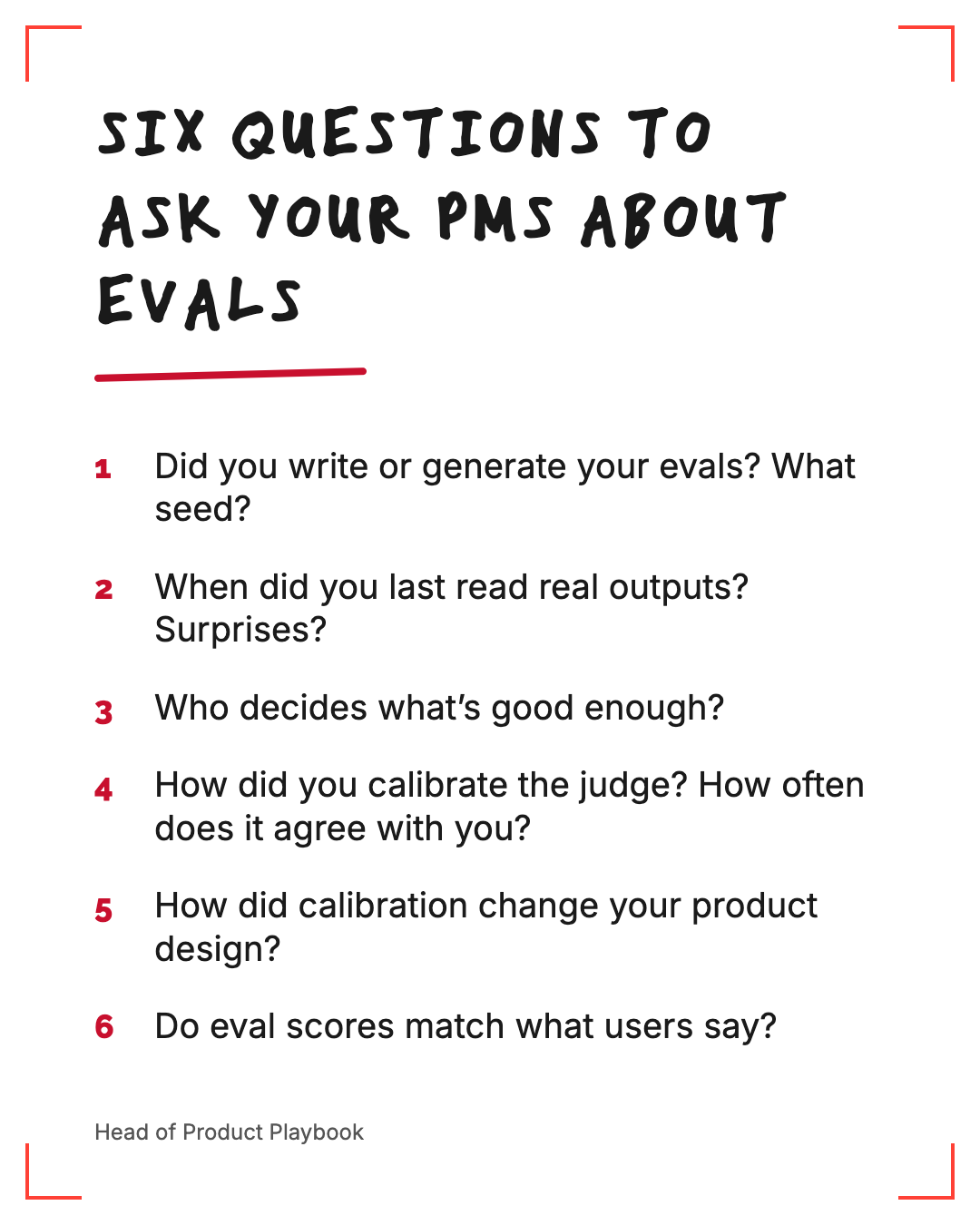
In your next 1:1 with a PM embedding models in their software, ask:
Did you write your eval cases or generate them? What did you seed them with?
When was the last time you read real outputs? What surprised you?
Who decides whether the model outputs are good enough?
How did you calibrate the judge, and how often does it agree with you?
What did you learn in calibration that changed your product design?
How do the eval scores map to what users are saying?
What this means for hiring
In the past, we might have asked a QA engineer to juggle these kinds of details. I believe PMs should drive the calibration, but many companies are short on PM capacity as they wait to see how agentic work shapes up.
But: as we increase the speed of engineering, we have more features to judge; more UX to refine; more quality challenges. So there's an argument to be made that we need to hire more people with QA backgrounds, especially when models are a core part of our product.
We can't simply add to the PM workload without hiring more PMs. I haven't seen any evidence yet that a team doing agentic work has less demand on the PMs. The more we hand off to agents, the more output there is to inspect and judge, and it's a qualitative judgement that matters. We still need input from real users to know if the results are meaningful.
I'm researching how different companies are rethinking staffing balance for a future play. If you are wrestling with this and can spare 15 minutes for a chat, I'd love to hear from you.
Back to my landlord's chatbot. What do I wish the developer had done? What would 'good' look like?
- recognizing that none of the options in the dropdown matched my scenario
- making a judgement call
- flagging this as 'other, urgent'
- creating a feedback loop to the software vendor to figure out why this case was not classifiable.
The exciting part of AI is that LLMs have the potential to do so much more than fill in forms - to detect when things have gone out of bounds and to either alert or improvise. But if we stop at just the simple eval and the judging, we are missing the chance to build software that actually responds to what users feel when they're using it. That's the interesting frontier here.
I wanted so badly to share that frustration with the landlord and the software vendor. But there was no path to do this. So I suffered in silence. What a missed opportunity. Let's do better.